



Tag Archives: Multifamily market trends

22.4 Million Renters and Counting: Multifamily Renter Demand Hits a Record

Multifamily renter demand

Multifamily renter demand in the U.S. has quietly reached a historic milestone.

In 2025, the number of multifamily rental households climbed to 22.4 million, the highest level ever recorded, according to research from Chandan Economics and Arbor Realty Trust.

This isn’t a short-term spike or a post-pandemic anomaly. It’s the continuation of a multi-year structural shift that is reshaping the housing landscape—and creating long-term implications for investors focused on durable income and demand-backed assets.

A Growth Trend with Staying Power

Multifamily household formation has now grown at a steady 1.6%–1.8% annual rate for three consecutive years. From 2020 to 2025, the sector expanded by 15.4%, dramatically outpacing the 5.3% growth in total U.S. households over the same period.
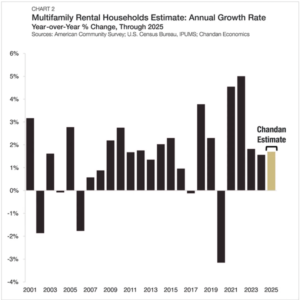
 

22.4 Million Renters and Counting…

In absolute terms, the U.S. added nearly 3 million multifamily households over the past five years, the largest net gain since 2000.

For investors, the significance lies less in the headline number and more in the consistency. This level of growth suggests not a cyclical surge, but a durable rebalancing of where and how Americans choose, or are forced, to live.

Supply Has Risen—but So Has Absorption

Importantly, this demand growth has occurred alongside a historic wave of new supply. In 2024 alone, developers delivered 591,400 multifamily units, the highest annual total since 1974. Through August 2025, another 328,500 units came online, keeping completions elevated.

Rather than overwhelming the market, this supply surge has largely been absorbed.

Without it, household growth within multifamily would have been constrained, placing even greater pressure on rents and occupancy. Instead, new deliveries helped accommodate record demand while preventing excessive overheating in many markets.

This balance between supply and demand has been a key factor in the sector’s resilience.

Structural Demand Drivers Remain Intact

Several long-term forces continue to support multifamily growth.

The cost of homeownership has moved further out of reach, with mortgage payments, insurance, and taxes consuming approximately 43% of median household income, well above traditional affordability thresholds. At the same time, return-to-office policies have reinforced demand in employment-dense metros, particularly among renters seeking proximity and flexibility.

In certain Sun Belt markets, rising numbers of high-income renters are adding competitive pressure to the rental pool, further reinforcing demand even as new supply delivers.

Together, these forces suggest that multifamily demand is not solely a function of interest rates or short-term economic conditions, but a reflection of broader affordability and lifestyle realities.

What This Means For Investors in 2026

Despite record household counts and elevated deliveries, occupancy has remained relatively stable, and rent pressure has moderated rather than collapsed. This points to a market that is absorbing growth, not struggling under it.

As construction pipelines begin to normalize and demand drivers remain structurally intact, the multifamily sector is expected to enter 2026 on more balanced footing, characterized by steadier household growth, stabilized rents, and improved visibility for long-term investors.

For accredited investors, this matters because durable demand is the foundation of every successful multifamily strategy. Record household formation doesn’t guarantee outsized returns on its own, but it does create a strong base for disciplined operators, selective market exposure, and strategies focused on sustainability rather than speculation.

In a housing market defined by affordability constraints and evolving lifestyle preferences, multifamily’s growth story appears less cyclical and more structural, and increasingly difficult to ignore.

When You’re Ready… Here’s 3 Ways We Can Help:

  1. Connect With Our Team: Whether you’re exploring passive real estate for the first time or you’re a seasoned investor looking for a trusted partner, our team is available to answer your questions. Schedule a confidential strategy call to learn more about our investment philosophy, current opportunities, and how we help investors achieve income, growth, and tax efficiency. 
  2. Join Our Private Investor Portal: Gain exclusive access to our current offerings and ongoing pipeline of multifamily investments. Inside, you’ll find detailed financials, market insights, and structured deal overviews—all designed to help you make informed, confident decisions about where to place your capital.
  3. Review Our Investment Strategy: Get a clear understanding of how we source, underwrite, and manage multifamily assets. Our strategy is built around long-term wealth creation, consistent passive income, and disciplined risk management. Learn what sets us apart and why sophisticated investors choose to partner with us.

Fannie Mae Multifamily Inspections: Why Oversight Is Increasing Nationwide

Fannie Mae multifamily inspections

GSE inspections are ramping up nationwide and the reason may go deeper than most think.

If you own or asset-manage multifamily properties financed through Fannie Mae, you may have noticed something unusual lately, unannounced inspections and even requests for new Property Condition Assessments (PCAs).

You’re not imagining it. This trend is spreading across portfolios nationwide, and it’s catching many operators off guard. The question is why now?

A Quick Refresher: What Is a GSE?

Fannie Mae (along with Freddie Mac) is a Government-Sponsored Enterprise (GSE) a federally chartered organization created to stabilize and support the U.S. housing market.

Rather than lending directly, GSEs buy and securitize loans from lenders, guaranteeing those mortgage-backed securities (MBS). That guarantee comes with strings attached strict standards, ongoing oversight, and compliance with the Multifamily Selling & Servicing Guide.

Why the Surprise Inspections and PCA Demands?

Over the past year, Fannie Mae has tightened its operational oversight. Several factors are driving the increased activity:

1. A Tougher Market and Rising Credit Risk

With interest rates at multi-decade highs, rent growth slowing, and delinquencies inching upward, Fannie Mae is taking a harder look at collateral quality. These inspections identify deferred maintenance or early signs of distress before losses occur.

2. Recent Guide Updates and Stricter Enforcement

Fannie Mae’s updated PCA guidance now classifies more items as “immediate repairs” from obsolete electrical systems to life-safety deficiencies. The message: compliance delays are no longer acceptable.

3. Deferred Maintenance in Older Assets

Many Class B and C communities are showing age. Deferred CapEx that built up post-COVID has become impossible to ignore. Fannie Mae isn’t waiting for defaults to uncover problems it’s proactively visiting assets.

4. Servicers Under Pressure

Servicers, acting on Fannie Mae’s behalf, are required to perform more on-site verifications for watch-list or at-risk loans. The result: more frequent inspections, shorter notice windows, and higher scrutiny.

A Personal Theory: The 2021–2022 Wave of New Operators

Here’s the part few are talking about and it may explain the sudden surge in oversight.

Between 2021 and 2022, multifamily experienced one of the largest influxes of new syndicators and operators in its history. Capital was abundant, rates were low, and value-add plays looked like a sure bet.

According to Newmark, multifamily investment volume hit $353 billion in 2021 and $294 billion in 2022, roughly 75 percent above pre-pandemic norms. That velocity invited first-time sponsors to chase Class B and C deals in fast-growing Sunbelt markets.

Meanwhile, crowdfunding and syndication platforms like CrowdStreet expanded rapidly, reporting billions in equity raised by late 2022. Smaller, newer operators suddenly had access to capital they’d never had before.

Then the cycle turned. Rates doubled. Insurance, payroll, and taxes skyrocketed. Rent growth flattened.

Many of those operators who built underwriting models on aggressive rent premiums and short value-add timelines had to divert CapEx to operations just to keep the lights on. Renovations stalled. Capital reserves evaporated. Assets slid into partial completion limbo.

It’s entirely plausible that Fannie Mae and other GSEs noticed. Their loans were underwritten on the assumption of completed upgrades and adequate reserves. When those improvements didn’t materialize, the physical condition of the collateral inevitably declined.

So while these “unannounced” inspections might feel abrupt, they’re likely a data-driven response to that 2021–2022 operator cohort an industry class that entered at the top of the market cycle and never fully executed its business plans.

Why It Feels Unannounced

Technically, Fannie Mae’s guide requires advance notice before inspections. But in practice, servicers facing higher risk scores are shortening lead times or conducting on-site visits with minimal notice.

To property teams, that feels like a surprise. To the GSE, it’s “enhanced surveillance.”

How Owners and Asset Managers Can Stay Ahead

  1. Review Your Loan Documents. Confirm inspection and PCA rights, some loan riders allow more aggressive timelines.
  2. Document Every Visit. Record date, attendees, and scope to maintain transparency.
  3. Audit Your Own Properties. Catch deferred items before the lender’s report does.
  4. Engage Your Servicer Proactively. Ask if your asset is under broader review or watch-list criteria.
  5. Revisit Reserves and Forecasts. Reclassify “deferred” into “immediate” where necessary and plan funding now.

The Bigger Picture

This isn’t about micromanagement, it’s about risk management. Fannie Mae’s actions reflect the reality of 2025’s market: tightening liquidity, aging assets, and the natural correction following a historic capital surge.

And perhaps, it’s also a marker of a maturing industry. When CapEx gets repurposed for survival, properties age faster and the agencies are watching.

Final Thought

This trend isn’t isolated to one region or asset class it’s a nationwide tightening of standards across GSE-backed multifamily loans.

Whether you manage 200 units or 2,000, now is the time to ensure your documentation, reporting, and property condition are bullet-proof.

Because when the GSE knocks, even unannounced, it’s too late to start cleaning up.


Meaghan Davenport President of Operations, Axxis Capital Helping owners and operators think bigger about performance, compliance, and accountability.

About the Author: Meaghan Davenport is a seasoned asset management executive and multifamily syndicator with a proven track record in operational turnarounds, value creation, and team leadership. Her work focuses on elevating industry standards through transparency, data-driven oversight, and collaboration between ownership, management, and investors.

Sources: Fannie Mae Multifamily Selling & Servicing Guide (2025); Newmark Multifamily Capital Markets Report (2022); CrowdStreet Annual Report (2022); CBRE U.S. Market Outlook (2022).