



Let’s start with an honest observation. Most accredited investors we talk to have done a lot of things right. They’ve earned well. They’ve saved consistently. They have a diversified brokerage account, a maxed-out retirement plan, maybe a rental property or two. Some have a business generating real cash flow.
And yet…when you actually map out how their wealth is structured, a pattern emerges. Nearly everything they own responds to the same forces: interest rates, market sentiment, inflation, and tax policy. It all moves together. Sometimes up, sometimes down, but rarely independently.
It’s correlation dressed up as diversification. And for high earners in particular, it creates a ceiling that’s difficult to see until you’re up against it.
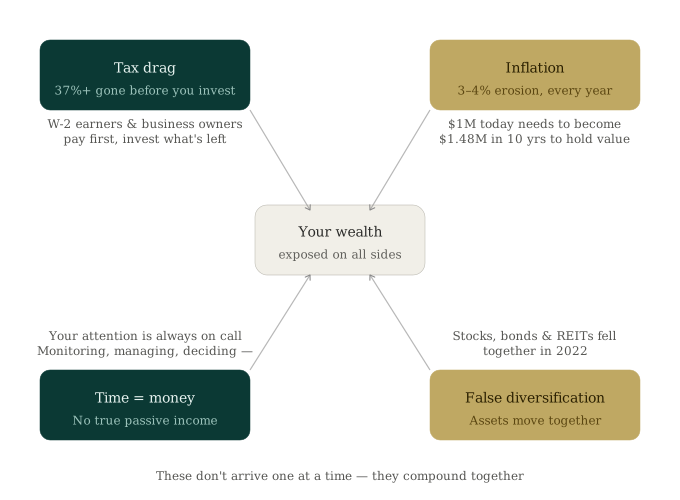
The Four Forces Working Against You
Consider what most sophisticated investors are actually dealing with at any given time:
Taxes arrive before your capital does. If you’re a high earner, you’re likely losing 37% or more of every additional dollar before you can deploy it. Most strategies help you invest what’s left. Very few help you change the structure of what’s taxed in the first place.
Inflation is a constant. A 3–4% annual erosion in purchasing power sounds abstract until you realize that $1M in savings today needs to become $1.48M in ten years just to maintain its real value. Most fixed-income and cash-equivalent holdings don’t come close to clearing that bar.
Your time is still in the equation. Even investors who consider themselves “passive” are often more active than they realize – monitoring positions, rebalancing, managing a rental property, making decisions. True passivity is rare, and rarer still is income that grows without any corresponding demand on your time.
Most portfolios are less diversified than they look. Stocks, bonds, REITs, mutual funds – in a significant market dislocation, these assets tend to move in the same direction at the same time.
What Passive Multifamily Investing Actually Does Differently
Multifamily investing – specifically, ownership stakes in professionally managed apartment communities – is a different structural position in the economy. And that distinction matters more than most investors realize.
When you own a piece of a multifamily asset, you’re not betting on a market. You’re owning a service that people need regardless of what that market does.
Rents are tied to local employment and housing demand – not Fed policy or earnings reports. When inflation rises, so do rents, and so does the replacement cost of the building itself. The asset appreciates in nominal terms precisely because of the forces that erode your savings elsewhere.
From a tax standpoint, the structure is categorically different. Depreciation – and more specifically, accelerated depreciation through cost segregation – creates paper losses that can offset real income. For accredited investors who qualify, this can shelter not just passive income but, in certain cases, active W-2 income as well. This isn’t a loophole. It’s a deliberate feature of the tax code that rewards long-term capital formation in housing.
And critically – when structured as a passive syndication – it requires none of your time. The operator handles acquisition, management, capital improvements, and eventual disposition. You participate in the economics without participating in the operations.
Why This Feels Like a Missing Piece Rather Than a New Idea
Most investors, when they first understand how this works, don’t feel like they’ve discovered something exotic. They feel like they’ve finally seen a gap they knew was there but couldn’t name.
The reason is simple: the conventional financial system – advisors, brokerages, retirement accounts – isn’t designed to include this asset class. It’s not that it’s hidden. It’s that the infrastructure most people use to build wealth doesn’t have a place for it. Which means the investors who do access it tend to be those who actively sought it out, usually through relationships with operators and sponsors rather than through traditional channels.
That’s starting to change. But access still matters – and so does timing. The current environment, with a reset in valuations from the 2022–2023 rate cycle and persistent rental demand driven by the housing shortage, presents entry conditions that haven’t existed for several years.
When You’re Ready… Here’s 3 Ways We Can Help:
- Connect With Our Team: Whether you’re exploring passive real estate for the first time or you’re a seasoned investor looking for a trusted partner, our team is available to answer your questions. Schedule a confidential strategy call to learn more about our investment philosophy, current opportunities, and how we help investors achieve income, growth, and tax efficiency.
- Join Our Private Investor Portal: Gain exclusive access to our current offerings and ongoing pipeline of multifamily investments. Inside, you’ll find detailed financials, market insights, and structured deal overviews—all designed to help you make informed, confident decisions about where to place your capital.
- Review Our Investment Strategy: Get a clear understanding of how we source, underwrite, and manage multifamily assets. Our strategy is built around long-term wealth creation, consistent passive income, and disciplined risk management. Learn what sets us apart and why sophisticated investors choose to partner with us.